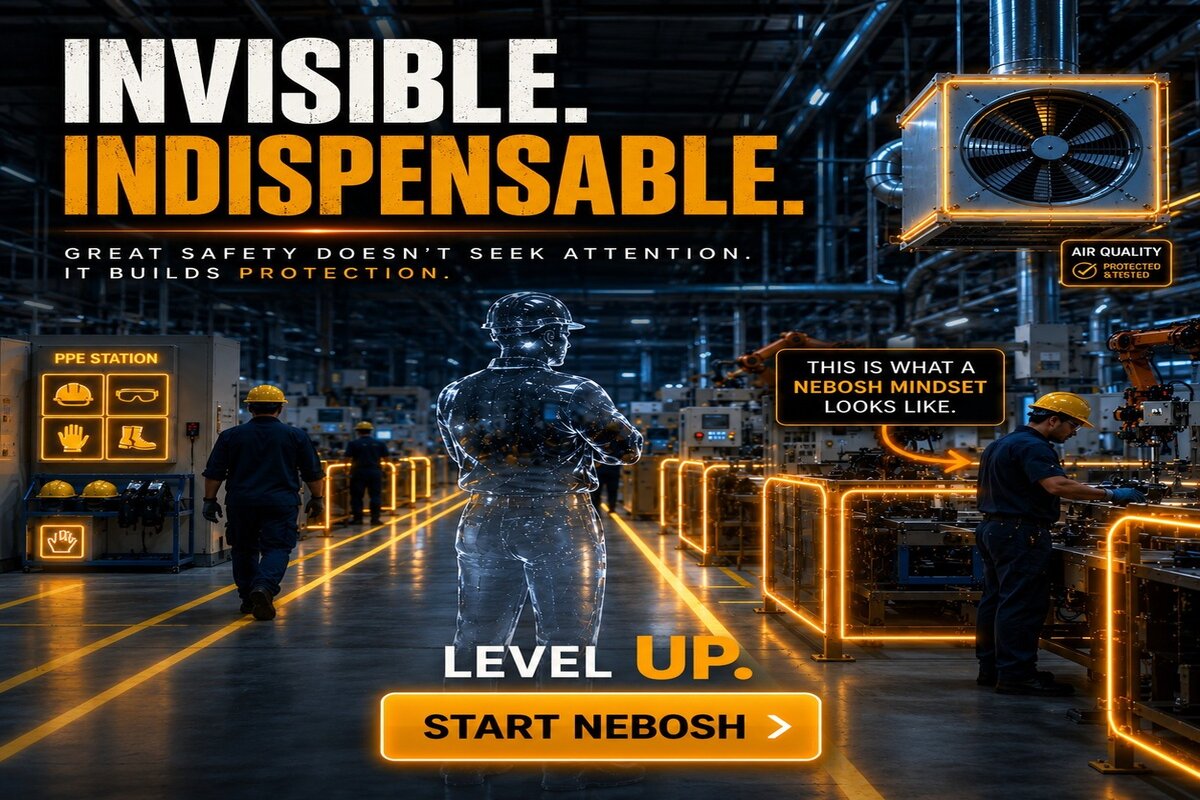
Saudi Arabia's Vision 2030 isn't just an economic roadmap — it's a workplace safety commitment on an unprecedented scale. As new cities, industrial zones, and tourism developments rise across the Kingdom, NEBOSH Courses are playing a quiet but essential role in making sure that growth doesn't come at the cost of worker safety.
Developments like NEOM, the Red Sea Project, and Qiddiya involve construction on a scale rarely seen anywhere in the world, employing hundreds of thousands of workers across complex, high-risk sites. Ensuring adequate safety oversight on projects of this size requires a steady pipeline of professionals trained through recognised programmes like NEBOSH Courses.
As international contractors partner with local firms on these giant projects, a NEBOSH Certificate has increasingly become a shared language of safety competence — understood and trusted by companies regardless of where they're headquartered. This shared standard helps multinational project teams collaborate more effectively on safety matters, reducing miscommunication that can otherwise lead to serious incidents.
With so many workers needing safety training simultaneously, understanding NEBOSH course requirements at an organisational level has become important for HR and HSE departments across the Kingdom. Because entry-level NEBOSH course requirements remain accessible to most staff, companies can roll out training across large teams without excessive barriers, while still maintaining rigorous standards.
To meet this demand, providers have expanded their NEBOSH Training capacity significantly, offering more frequent course dates, larger cohorts, and multiple delivery formats across Riyadh, Jeddah, and the Eastern Province. This expansion in NEBOSH Training availability has been crucial in keeping pace with the sheer scale of Vision 2030 construction activity.
As training volume increases, so does the temptation for lower-quality providers to enter the market. This makes verifying NEBOSH Gold Learning Partner status more important than ever for both individuals and companies. A genuine NEBOSH Gold Learning Partner ensures that rapid scaling doesn't come at the expense of teaching quality or exam integrity.
Vision 2030 isn't a short-term push — it's a multi-decade transformation, and the safety culture being built today will shape how Saudi Arabia's industries operate for generations. Professionals who invest in NEBOSH Courses now are positioning themselves at the centre of that long-term shift, not just responding to a temporary hiring trend.
Many of Saudi Arabia's mega-projects involve international partners who bring safety practices refined across decades of major infrastructure work in other parts of the world. Rather than simply importing these practices wholesale, the most successful projects blend global best practice with locally trained talent capable of applying those standards within the specific context of Saudi Arabia's climate, workforce composition, and regulatory environment. Building this local capacity through structured, internationally benchmarked training ensures the Kingdom develops lasting in-house safety expertise, rather than remaining permanently dependent on imported specialists for every major project.
Saudi Arabia's broader push toward workforce development and greater participation of Saudi nationals across skilled professional roles has an important safety dimension too. As more Saudi nationals move into engineering, supervisory, and management positions across construction and industrial sectors, structured safety education provides a clear, internationally recognised pathway into HSE careers specifically. Training providers across the Kingdom have responded by expanding capacity and, in some cases, tailoring cohort scheduling to support company-sponsored group enrolments aimed at building homegrown safety expertise.
Beyond immediate worker safety, large-scale developments are increasingly judged against broader environmental and social governance expectations from international investors and partners. Robust occupational safety practices, underpinned by properly trained staff, form a visible part of that broader governance picture. Projects that can demonstrate a well-trained safety workforce, backed by recognised qualifications, are often better positioned when engaging international financing partners or joint venture contractors who expect documented, globally benchmarked safety standards as a condition of involvement.
Will demand for this kind of training continue growing, or is it a temporary trend tied to current construction activity? Given that Vision 2030 initiatives span well over a decade, demand for qualified safety professionals is expected to remain strong for the foreseeable future, extending well beyond the current construction phase into ongoing operations and maintenance of these new developments. Are there opportunities for safety professionals beyond construction once these projects are completed? Yes — completed developments still require ongoing operational safety management, meaning trained professionals often transition smoothly from construction-phase roles into long-term operational safety positions.
Saudi Arabia's mega-projects are also testing grounds for new safety technology — wearable sensors that monitor worker fatigue, drone-based site inspections, and digital permit-to-work systems replacing paper-based processes. None of this technology replaces the need for well-trained human judgement, however; if anything, it raises the bar, since safety professionals now need to interpret data from these systems alongside traditional risk assessment skills. A strong foundational safety education makes it considerably easier to adapt to these emerging tools, since the underlying principles of hazard identification and risk management remain the same regardless of how information is collected.
As experienced HSE professionals across the Kingdom approach retirement or move into higher management roles over the coming years, a new generation will need to step into their positions. Encouraging early-career engineers, supervisors, and technicians to pursue structured safety education now is one of the clearest ways to build that leadership pipeline, ensuring the safety culture established during this current wave of development continues well into the future, long after individual mega-projects have moved from construction into full operation.
As the Kingdom's skyline continues to change, the professionals trained to keep those worksites safe will remain in steady demand. Building that expertise starts with the right qualification and the right training partner.
There's rarely a wrong time to invest in safety education, but there is a cost to delaying indefinitely while the industry around you continues to evolve and raise its own expectations. Professionals and companies that act early tend to find themselves ahead of the curve as standards continue tightening, rather than scrambling to catch up once compliance requirements or client expectations shift further in the years ahead.
Saudi Arabia's push toward stronger occupational safety standards isn't happening in isolation — neighbouring Gulf states are pursuing similarly ambitious development agendas, each requiring their own pipeline of qualified safety professionals. This regional momentum means demand for recognised, internationally portable safety qualifications is likely to remain strong not just within the Kingdom but across the wider Gulf region, giving professionals who invest in this training now genuine flexibility should career opportunities arise beyond Saudi Arabia's own borders in the years ahead.
Looking toward the next ten years, the pace of construction and industrial development across Saudi Arabia shows little sign of slowing, even as individual mega-projects move from initial construction into long-term operation. This shift will likely change the nature of safety roles somewhat, moving from a heavy focus on construction-phase hazards toward ongoing operational safety, maintenance risk management, and emergency preparedness for fully functioning cities, ports, and industrial facilities. Professionals who build a strong foundational understanding of safety principles now will be well placed to adapt to whichever direction this evolution takes, since the underlying skills of risk assessment, investigation, and clear communication remain relevant across every phase of a project's life.
No single training provider, employer, or government body can build a safer construction and industrial sector alone — it takes a shared commitment across all three. Regulators set the expectations, employers provide the opportunity and often the funding, and individual professionals bring the discipline to actually complete their studies and apply what they've learned daily. As Saudi Arabia's development story continues to unfold over the coming years, this shared responsibility will remain central to ensuring that ambitious construction targets are met without compromising the safety of the workforce making them a reality.
The scale of transformation happening across Saudi Arabia right now is genuinely historic, and the safety professionals trained today will be the ones ensuring that transformation happens responsibly. Whether you're an individual considering your next career step or a company planning workforce development for the years ahead, investing in recognised, high-quality safety education remains one of the clearest, most future-proof decisions available in this rapidly evolving market.
Be part of Saudi Arabia's safety-first future. Enroll in a NEBOSH course now and help build the workplaces of tomorrow, safely.

This post has been authored and published by one of our premium contributors, who are experts in their fields. They bring high-quality, well-researched content that adds significant value to our platform.











Ride Connect is your online source for useful automobile guides, vehicle tips, maintenance advice, driving information, and automotive insights. Explore our latest content and stay connected with the world of automobiles.