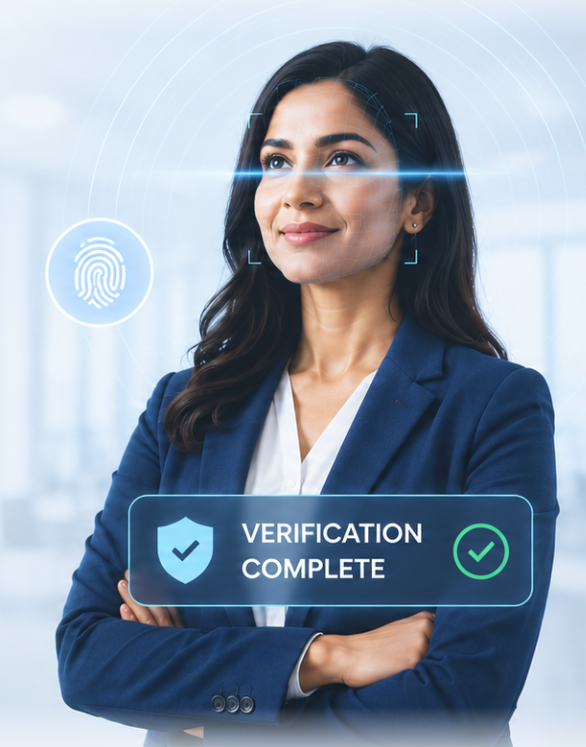
As digital services become an essential part of everyday life, organizations need reliable ways to verify identities while protecting users from fraud. Traditional passwords and knowledge-based authentication are increasingly vulnerable to phishing, credential theft, and social engineering. Modern technologies such as NFC identification and voice biometrics authentication are helping businesses build stronger, faster, and more convenient identity verification processes.
NFC identification uses Near Field Communication (NFC) technology to read information stored on compatible identity documents, cards, smartphones, or other NFC-enabled devices. By establishing a short-range wireless connection, an NFC reader can securely retrieve relevant data and use it as part of an identity verification workflow.
NFC identification can be particularly valuable when organizations need to verify information from modern electronic identity documents. Instead of relying solely on manually entered information, businesses can use NFC-enabled technology to obtain structured data directly from supported sources.
This can reduce manual errors while improving the speed and consistency of digital onboarding. NFC identification can also be combined with document verification, facial biometrics, and other security checks to create a more comprehensive identity verification process.
Voice biometrics authentication identifies or verifies a person by analyzing distinctive characteristics of their voice. Unlike conventional voice recognition, which primarily focuses on understanding spoken words, voice biometrics evaluates characteristics associated with the speaker.
These characteristics can include vocal patterns, pitch, pronunciation, rhythm, and other acoustic features. Advanced biometric systems convert these characteristics into a mathematical representation that can be compared against a previously enrolled voice profile.
Voice biometrics authentication can provide a convenient additional authentication factor for applications where users need to confirm their identity remotely. It can be useful in customer support, financial services, telecommunications, digital onboarding, and other environments where secure remote interactions are important.
Using NFC identification and voice biometrics authentication together can create a stronger identity verification framework. Each technology addresses a different part of the verification process.
NFC identification can help establish information associated with a supported electronic identity document, while voice biometrics authentication can provide a biometric layer associated with the individual.
For example, during a digital onboarding process, a user may first provide an NFC-enabled identity document. The system can extract available information and perform appropriate document checks. The user can then complete a voice-based biometric verification step. Combining these signals can provide organizations with multiple data points for evaluating whether an identity claim is trustworthy.
Integrating these technologies can provide several advantages:
NFC identification and voice biometrics authentication can support identity-focused workflows across multiple industries. Financial institutions can use them during digital account opening and customer verification. Telecommunications providers can apply biometric authentication to protect customer accounts and services.
Travel and hospitality organizations may also benefit from faster identity checks, while healthcare, insurance, and online platforms can use identity verification technologies to reduce impersonation and unauthorized access.
No single technology should be viewed as a complete solution for every identity threat. Organizations should design verification systems according to their risk profile, regulatory requirements, user experience goals, and data-protection responsibilities.
NFC identification and voice biometrics authentication can become valuable components of a broader identity verification strategy when combined with appropriate document checks, biometric verification, fraud detection, and security controls.
As digital transactions continue to grow, businesses need authentication technologies that balance security with convenience. NFC identification can simplify electronic identity data capture, while voice biometrics authentication adds a biometric layer for remote identity verification. Together, they can help organizations create more efficient, flexible, and secure digital identity experiences for modern users.

This post has been authored and published by one of our premium contributors, who are experts in their fields. They bring high-quality, well-researched content that adds significant value to our platform.










Ride Connect is your online source for useful automobile guides, vehicle tips, maintenance advice, driving information, and automotive insights. Explore our latest content and stay connected with the world of automobiles.