Balconies are an important feature of many Florida hotels, apartment properties, condominiums, and other multi-story buildings. Because balconies, railings, platforms, and stairways are exposed to weather and regular use, keeping them in safe condition is an important responsibility for property owners and managers.
Understanding Florida balcony inspection requirements can help property owners stay organized, identify potential safety concerns, and avoid problems associated with expired inspection certificates or deteriorated structural components.
In 2026, Florida property owners should also understand that a balcony inspection certificate for certain public lodging establishments is different from the state's separate milestone inspection requirements for qualifying condominium and cooperative buildings.
Florida has specific balcony inspection requirements for certain public lodging establishments.
Under Florida's rules, a public lodging establishment that is three or more stories in height must submit a certificate stating that its balconies, platforms, stairways, and railings or railways have been inspected by a person who is competent to inspect multi-story buildings. The inspected components must be found safe, secure, and free of defects.
The requirement is particularly important for hotels, vacation properties, and other establishments regulated as public lodging facilities.
Property owners should determine whether their specific property falls within the applicable public lodging requirements rather than assuming every residential balcony is governed by the same certification process.
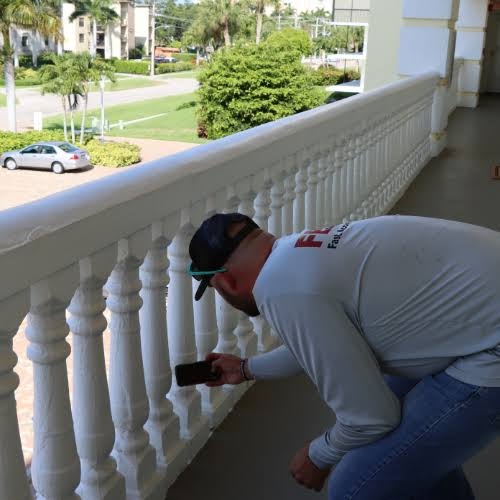
A balcony inspection is not limited to the walking surface of the balcony.
Florida's DBPR balcony certificate identifies several areas that may need to be inspected, including:
The current DBPR HR-7020 form states that the inspection covers these components and requires the inspector's competency to be established.
This broader scope is important because a balcony can appear visually sound while a railing, connection, stairway, or other component requires attention.
One of the most important parts of Florida balcony inspection requirements is the inspection cycle.
For public lodging establishments covered by the rule, the Certificate of Balcony Inspection is valid for three years from the date the inspection was completed. A new certificate must be filed with the Division and applicable local government agency every third year, before the previous certificate expires.
Property managers should therefore keep track of the certificate's expiration date rather than waiting until the last minute.
An expired certificate can become a compliance issue. Florida DBPR inspection records have documented violations involving expired or missing balcony certificates at three-story properties.
Florida's DBPR rules require the inspection to be performed by someone competent to inspect multi-story buildings through education and experience.
The operator is responsible for verifying the inspector's competency, and that verification must be documented on the applicable form.
This makes choosing an appropriately qualified professional an important part of the process.
Property owners should not select an inspector based solely on price. Experience with multi-story properties, balconies, railings, platforms, and related building components can be particularly valuable when evaluating an older or heavily used property.
The DBPR HR-7020 Certificate of Balcony Inspection is the form used for balcony certification under the applicable Florida lodging rules.
The form requires information about the establishment and inspection, including the number of areas inspected, the number of defects found, the date repairs were completed when applicable, and information establishing the inspector's competency.
The form also requires the inspector and operator to sign the applicable sections.
Property owners should keep the stamped certificate available because Florida's administrative rules require the operator to maintain a copy that can be provided for inspection upon request.
Finding a defect does not mean a property should simply ignore the problem or wait until the next inspection cycle.
Potential concerns may include deteriorated railings, loose components, damaged stairs, concrete deterioration, exposed reinforcing steel, or other visible conditions affecting the safety of a balcony or platform.
Florida DBPR's published violation guidance identifies issues such as railing disrepair, missing railings, spalling concrete, exposed reinforcing steel, and deteriorated stairs as potential violations requiring attention.
Repairs should be evaluated and completed by appropriately qualified professionals. Depending on the nature of the problem, structural or engineering expertise may be necessary.
A common source of confusion is treating all Florida balcony inspections as one requirement.
They are not.
Florida's milestone inspection program applies to qualifying condominium and cooperative buildings that are three habitable stories or more in height. Under the current statute, these buildings generally must undergo a milestone inspection by December 31 of the year they reach 30 years of age and every 10 years afterward. Local enforcement agencies may require an earlier initial inspection, including at 25 years under specified circumstances.
A milestone inspection is a broader structural inspection performed by a Florida-licensed architect or engineer. It evaluates major structural components and systems and can involve a second phase when substantial structural deterioration is identified.
Therefore, a property owner or condominium association should determine which inspection requirement applies to the building rather than assuming that one inspection automatically satisfies every applicable requirement.
Meeting an inspection deadline is only one part of responsible property management.
Balconies are continually exposed to Florida's heat, rain, humidity, wind, and coastal conditions. Over time, moisture intrusion, corrosion, deterioration, drainage problems, and normal wear can affect building components.
Regular maintenance can help identify problems before they become more serious. Property managers should pay attention to:
Visible concerns should be evaluated rather than dismissed as normal aging.
Property owners and managers can take several practical steps to stay prepared.
First, determine whether the property is subject to the public lodging balcony certification requirements.
Second, check the date of the current Certificate of Balcony Inspection and schedule the next inspection before it expires.
Third, maintain documentation, including inspection certificates and repair records.
Fourth, make balconies, stairs, platforms, and railings accessible for inspection.
Finally, if the property is a qualifying condominium or cooperative building, determine whether Florida's milestone inspection requirements also apply.
Keeping these requirements separate can make compliance much easier to manage.
Understanding Florida balcony inspection requirements is an important part of protecting occupants, maintaining a property, and staying ahead of potential compliance issues.
For covered public lodging establishments, the DBPR balcony certification process includes a three-year inspection cycle and requires documentation through the appropriate certificate. At the same time, qualifying condominium and cooperative buildings may have separate milestone inspection obligations focused on overall structural integrity.
In 2026, property owners should take a proactive approach: know which requirements apply, keep certificates current, address visible deterioration, and work with qualified professionals when specialized evaluation or repairs are needed.
A well-maintained balcony is not simply an attractive property feature—it is an important part of building safety and responsible property management.

This post has been authored and published by one of our premium contributors, who are experts in their fields. They bring high-quality, well-researched content that adds significant value to our platform.










Ride Connect is your online source for useful automobile guides, vehicle tips, maintenance advice, driving information, and automotive insights. Explore our latest content and stay connected with the world of automobiles.